This article explores how frass, a byproduct of insect breeding, can be transformed into biochar as part of a circular bioeconomy model. Through this approach, it is shown how a material of biological origin acquires new value, contributing to carbon capture, soil improvement and waste reduction.
Circular Production
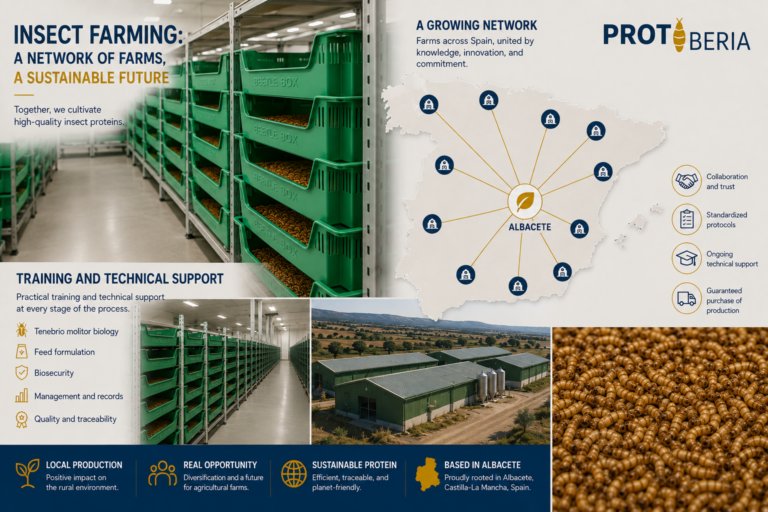
The transition to more sustainable production models is one of the major challenges in the agri-food sector. In this context, circular economy becomes a real necessity that allows waste reduction, resource optimization and minimization of environmental impact. The production of insects, and in particular Tenebrio molitor, is presented as an innovative solution capable of integrating these principles in a practical way.
Within this model, frass, a byproduct generated during insect breeding, takes on a key role. Beyond its traditional use, frass can become a strategic raw material for new circular applications. One of the most promising is its transformation into biochar, a material with great potential for soil improvement and carbon capture.
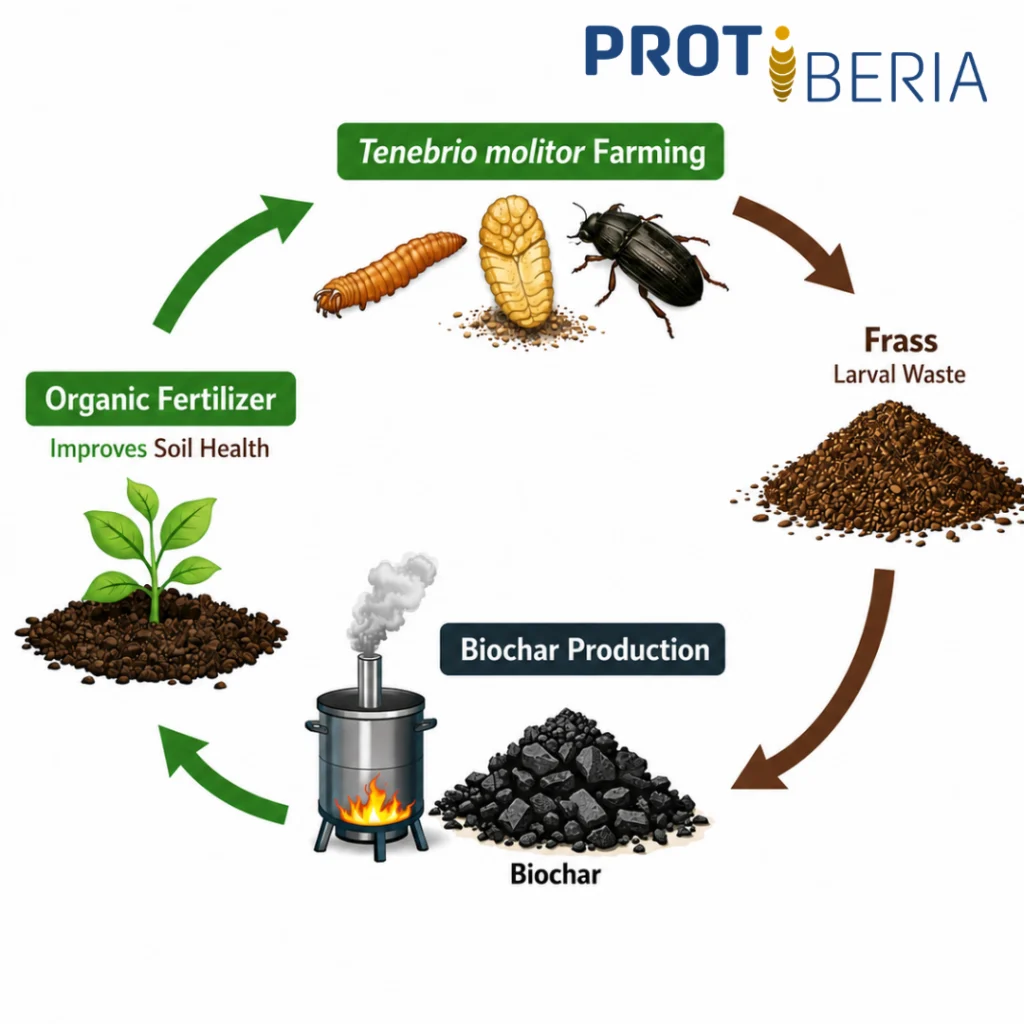
Frass and biochar: a new opportunity within the circular economy
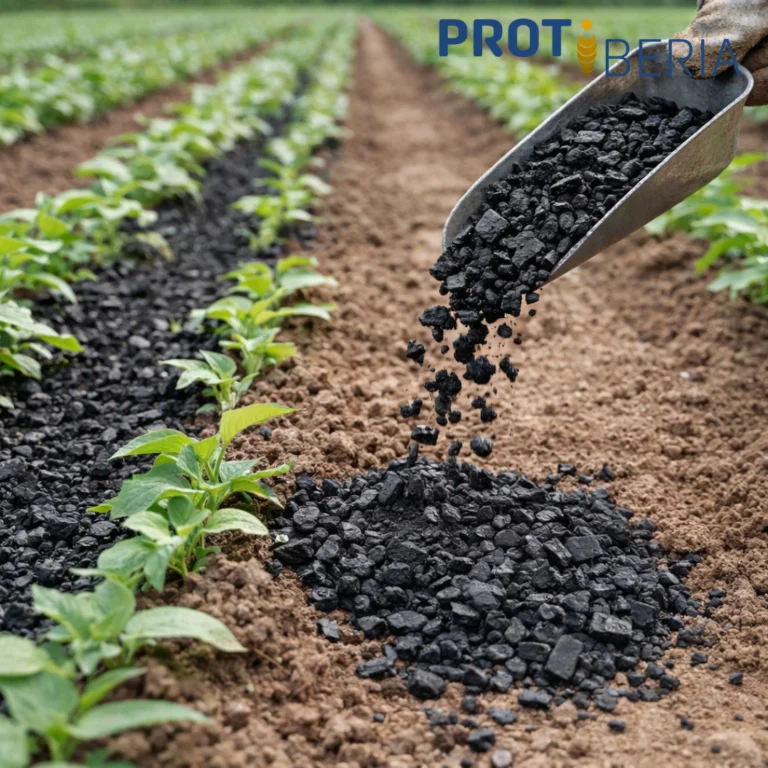
Biochar is a charcoal obtained from biomass pyrolysis under controlled conditions. It has traditionally been produced from plant or forest remains, but frass represents an innovative alternative within a circular bioeconomy model. Its biological origin and composition make it an interesting candidate for this process.
The transformation of carbon into biochar allows for a longer carbon life cycle, preventing it from returning quickly to the atmosphere in the form of CO2. This reinforces the role of insect production as a tool not only for sustainable protein, but also for climate change mitigation.
This approach fits perfectly with Protiberia model, which is based on making full use of the resources generated during insect breeding. Thus, products such as frass are no longer considered secondary by-products but become key assets of the production system.
From by-product to resource: frass as a sustainable asset
One of the fundamental principles of the circular economy is to eliminate the concept of waste. In this sense, frass represents a clear example of how a material generated during production can acquire new added value. When transformed into biochar, frass becomes part of a chain of long and efficient use.
Among the main benefits of frass-based biochar are:
- Improves soil structure and stability.
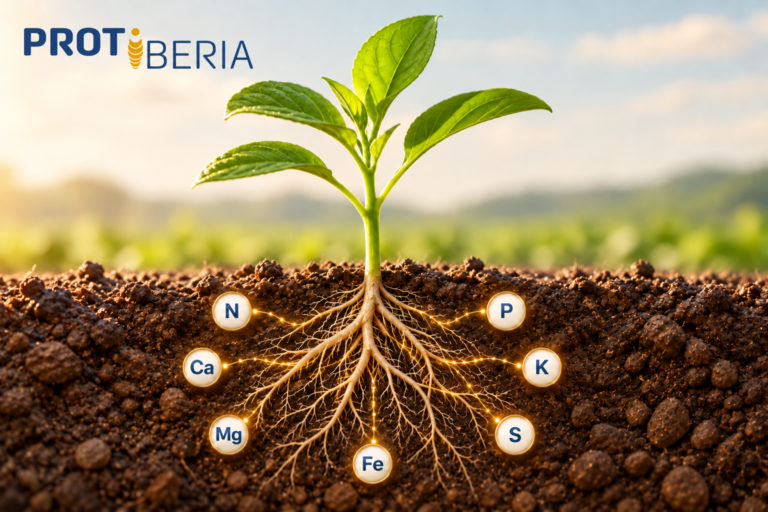
- Increased nutrient holding capacity.
- Contribution to long-term carbon capture and storage.
- Reduced dependence on fossil-based inputs.
Such solutions reinforce the idea that sustainability and economic viability can go hand in hand. The valorization of frass through biochar not only reduces environmental impact, but opens new opportunities within a circular and diversified business model.
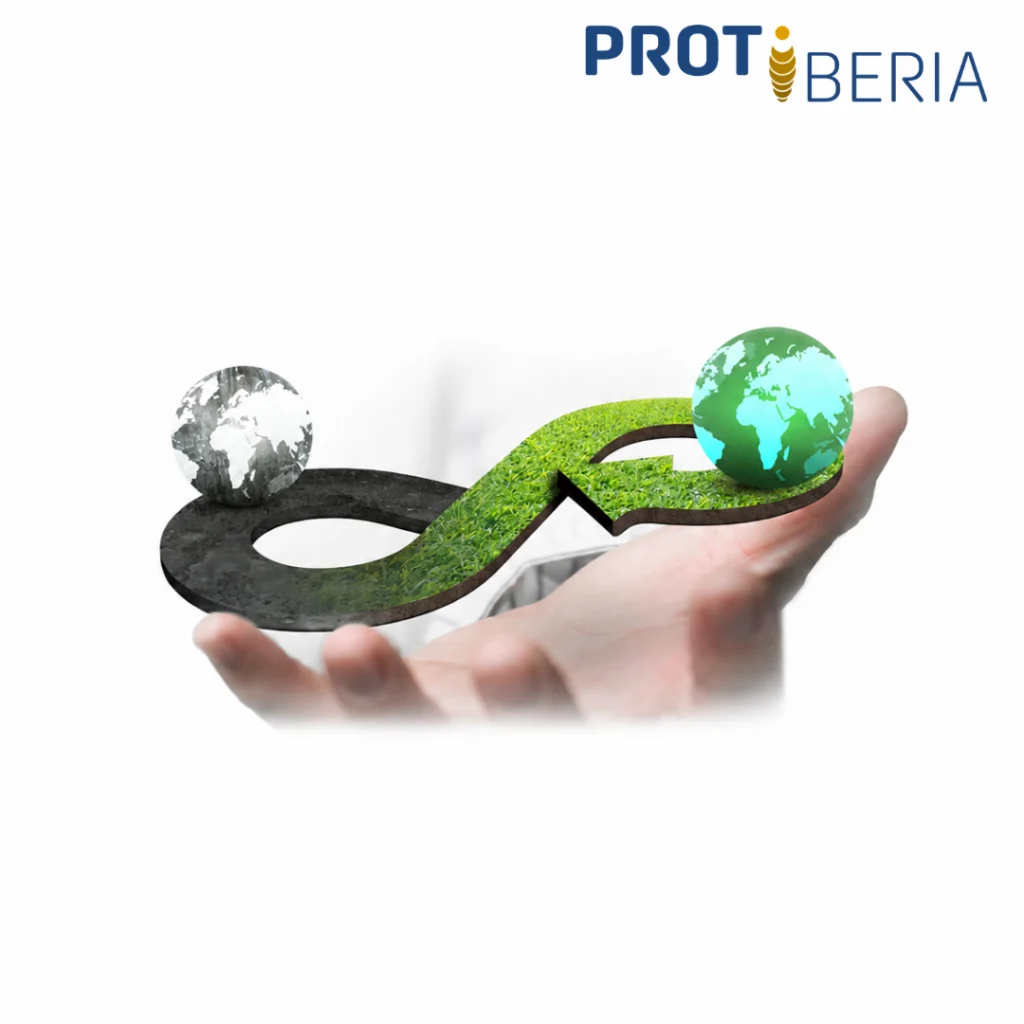
Insect production and long-term circular models
The integration of frass in processes such as biochar production demonstrates that insect breeding can act as a central hub of circularity within the agrio-food system. From feeding insects to exploiting all the flows generated, the model allows maximizing the efficiency of available resources.
At Protiberia, this approach aligns with a long-term vision based on:
- Reducing waste throughout the entire value chain.
- The development of sustainable solutions for agriculture.
- The creation of synergies between production, innovation and environmental care.
In this context, frass becomes a tangible element that demonstrates how the circular economy can be applied in a real and measurable way, beyond theoretical discourses.
Final reflection
The transformation of frass into biochar is a clear example of how applied innovation can drive more sustainable and planet-friendly production models. This approach demonstrates that the circular economy is not just about recycling, but about rethinking processes to generate long-term value.
Betting on solutions such as biochar derived from frass allows progress towards more resilient agriculture, healthier soils and productive systems aligned with current environmental challenges. On this path, insect production is consolidated as a key piece of the transition to a truly circular and sustainable agri-food model.
References
-Ellen MacArthur Foundation. (n.d.). What is a circular economy?
https://ellenmacarthurfoundation.org/topics/circular-economy-introduction/overview
-European Biochar Foundation. (n.d.). What is biochar? https://www.european-biochar.org/en/what-is-biochar
-European Commission. (2020). A new circular economy action plan for a cleaner and more competitive Europe.
https://environment.ec.europa.eu/strategy/circular-economy-action-plan_en
-Lehmann, J., & Joseph, S. (Eds.). (2015). Biochar for environmental management: Science, technology and implementation (2nd ed.). Routledge.
https://doi.org/10.4324/9780203762264