| The insect protein sector enters a new phase after 2025. Which models are attracting investment in 2026 and why the market keeps growing at double-digit rates. |
Insect farming 2026: after the shake-out, capitalreturns to profitable models
The adjustment cycle that disrupted the insect farming sector between 2023 and 2025 did not mark its failure — it marked its transition toward maturity.
Cases like Ÿnsect, Agronutris, and Aspire Food Group exposed the limits of a capital-intensive model dependent on rapid scaling. Yet far from contracting, the market has continued to expand. In 2026, the sector enters a new phase: less narrative, moreo perational discipline, and a clear focus on profitability.
Current estimates place the global insect protein market for animal feed above 1.3 billion dollars, with annual growth in the 12–15% range through the end of the decade. Demand, particularly in aquaculture and premium pet food, remains solid and structural.
What changed was not the market. It was the way to approach it.
The adjustment: from hype to cost control
Companies that faced the greatest difficulties shared common characteristics: large-scale centralized facilities, high fixed costs, long ramp-up periods, and continuous dependence on external financing.
This model worked in an environment of abundant capital. But as global financial conditions tightened, the priority shifted from growth at any cost to proving real economic viability.
Today, investors analyze the sector through a different lens:
- Cost per tonne produced (€/t)
- Substrate supply stability
- Signed off-take agreements
- Time to reach nominal capacity
- Ability to modulate production volume
The lesson is clear: technology is no longer the main barrier — efficient industrial execution is.
The emerging model: distributed and scalable production
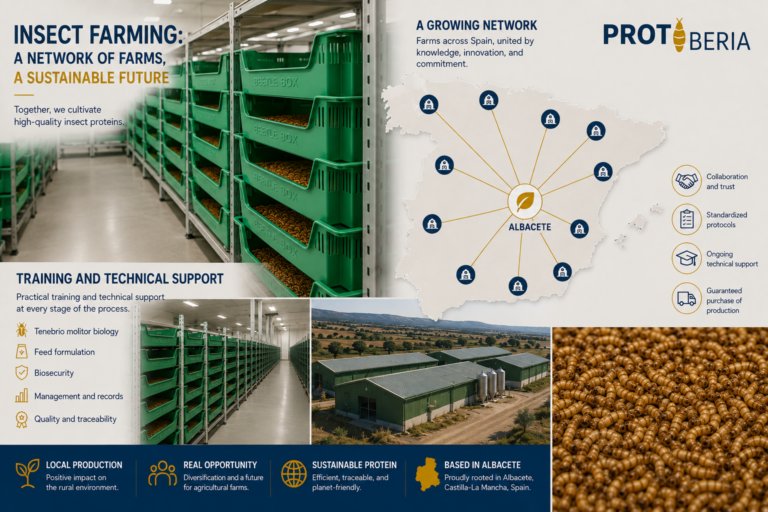
In this new context, a decentralized approach based on production networks is gaining significant traction.
A central operator concentrates genetics, R&D, processing, and commercialization, while smaller productive units handle the fattening phase. This model reduces capital intensity, improves operational resilience, and allows for progressive scaling.
Its advantages are particularly relevant for private capital:
- Lower Capex per productive unit
- Modular scalability without mega-facilities
- Diversification of operational risk
- Proximity to feed sources (agro-industrial by-products)
- Co-investment potential with local operators
This approach is already visible across multiple European geographies, with alliances between technology companies and agricultural cooperatives acting as deployment accelerators.
Tenebrio molitor: positioning in high-value segments
Although the black soldier fly (BSF) continues to lead in volume, Tenebrio molitor is consolidating its position in higher-value-added segments.
Its nutritional profile — high protein content, strong digestibility, and a complete aminoacid profile — positions it particularly well in:
- High-performance aquaculture
- Premium pet food nutrition
- Emerging functional applications
The regulatory environment also continues to evolve favorably across Europe and North America, expanding authorized uses and lowering market entry barriers.
Beyond the base product, the real value potential lies in fractionation: the proteinfraction, lipids, chitin, and bioactive compounds open the door to higher-margin markets, from specialized nutrition to cosmetics and veterinary pharmaceuticals.
Spain and Southern Europe: a structural competitiveadvantage
Southern Europe — and Spain in particular — offers especially competitive conditionsfor sector development:
- Access to agricultural by-products at low cost
- Favorable climate for key production phases
- Consolidated agro-industrial infrastructure
- Stable European regulatory framework
- Strategic need to reduce protein import dependency
Europe still imports the vast majority of its feed protein. This dependency is driving investment in local alternative sources, where insect protein plays an increasingly relevant role.
What capital is looking for in 2026
The investment profile has evolved clearly. Today, capital prioritizes:
- Models with controlled Capex and progressive scalability
- Projects with secured demand (signed contracts)
- Teams with operational experience, not just technological expertise
- Integration into existing value chains (feed, pet food, aquaculture)
- Demonstrable unit economics at small scale before expanding
In short: fewer promises of disruption, more evidence of execution.
A selective window of opportunity
The insect farming sector is not retreating — it is consolidating. The exit of oversized players has reduced competitive pressure and opened space for more efficient models.
For investors, this creates an unusual situation: a structurally growing market, with less competition and greater clarity on what actually works.
The opportunity no longer lies in betting on theoretical scale. It lies in identifying models that convert biology into profitable industry.