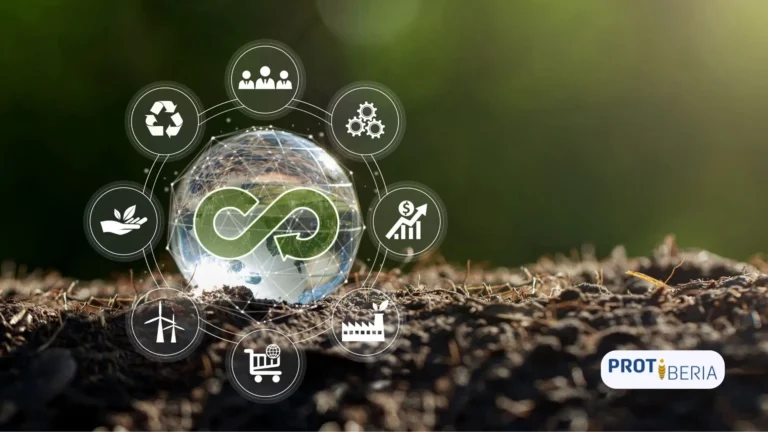
| Using agricultural by-products, Tenebrio molitor generates high-quality protein and a natural fertilizer that returns to the soil to regenerate it. This allows for the sustainable growth of crops, which in turn feed the insect. It is a perfect cycle where Tenebrio becomes the engine of a more efficient and regenerative production system. |
Frass, the natural fertilizer generated by Tenebrio molitor, is one of the few resources capable of returning exactly what agriculture demands to the soil: nutrients, microbiology, and structure. The most interesting aspect is not just its composition, but the process that makes it possible.
By processing agricultural by-products that are normally discarded, Tenebrio transforms them into protein and organic material. This return to the land allows crops to grow again, generating new by-products to feed the insect once more. A complete cycle where a natural biological material becomes the axis of a more efficient and environmentally friendly production system.
Tenebrio molitor as a Bioconversion Agent
Tenebrio molitor is an exceptional bioconverter capable of transforming agricultural by-products into high-value resources. By feeding on materials such as bran, vegetable scraps, or legume residues, the insect utilizes nutrients that would otherwise be lost, converting them into high-quality biomass. This process allows for the upcycling of secondary streams and reduces waste within the agri-food chain.
Following industrial production, three main products are obtained from Tenebrio:
- Tenebrio powder: A high-quality protein source for animal feed, noted for its digestibility and stability.
- Tenebrio fat: A natural oil with applications in animal nutrition.
- Frass: The insect’s dejections, an organic material composed of transformed food remains that acts as a natural fertilizer with enormous agronomic potential.
The ability of Tenebrio molitor to convert by-products into protein, fats, and frass makes it a key piece within a circular model. Each of these products has a useful and complementary destination, allowing the production cycle to close and moving toward more efficient, regenerative systems that are respectful of the environment.
Frass: Composition, Agronomic Value, and Regenerative Effect
Tenebrio molitor frass is a natural organic material. This mixture concentrates essential nutrients such as nitrogen, phosphorus, and potassium in plant-available forms, while providing a significant amount of organic matter that improves soil physical structure.
Beyond nutrients, frass contains beneficial microorganisms and bioactive compounds:
- Microbial Activity: These microorganisms contribute to nutrient solubilization and stimulate root development.
- Natural Defenses: The presence of chitin (from the insect’s exuviae or shed skins) and other natural molecules triggers defense mechanisms in plants, increasing their tolerance to hydric, saline, or biotic stress.
When incorporated into the soil, frass acts simultaneously as a fertilizer and a biostimulant. Its organic matter improves water retention, aeration, and soil aggregation, while its active microbiology drives processes that increase nutrient availability. Together, these effects make it possible to reduce dependence on synthetic fertilizers and move toward a more balanced, regenerative agriculture aligned with the principles of circularity.
The Complete Cycle: From Soil to Tenebrio and Back Again
The process connecting Tenebrio molitor, frass, and agriculture forms a circular system where each stage feeds the next. It is not a theoretical cycle: it is a real, continuous, and efficient flow that allows transforming by-products into value and returning fertility to the soil.
The following details each phase of the cycle:
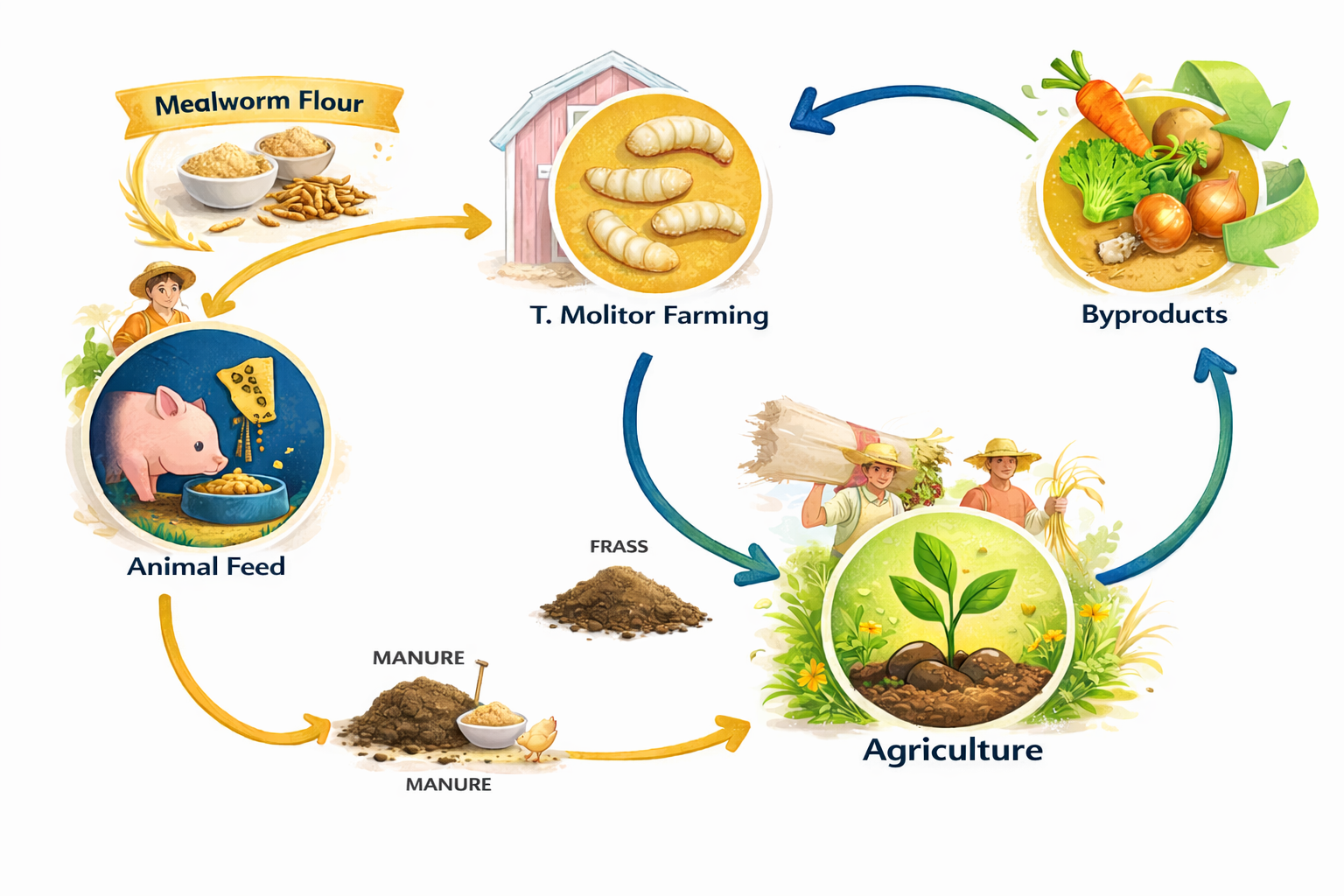
Soil as the starting point
Everything begins in the soil, which is the origin of agricultural crops. From it, cereals, legumes, fruits, and vegetables are born, feeding people, animals, and the agri-food industry. Soil quality determines crop quality, and its fertility depends on maintaining a balance between nutrients, microbiology, and organic matter.
Crops generate agricultural by-products
During food production and processing, by-products such as bran, vegetable scraps, fruit and vegetable discards, or legume residues are generated. In a linear model, these materials are wasted or used for low-value purposes. In a circular model, they become a key resource: the dietary base for Tenebrio molitor.
Tenebrio transforms these by-products into protein, fats, and frass
By feeding on these by-products, Tenebrio molitor performs a highly efficient bioconversion process. At the end of its productive development, it generates the three main products mentioned: protein powder, fat, and frass.
This stage is the heart of the cycle: it converts low-value materials into useful resources for agriculture and livestock.
Frass returns to the soil as a natural fertilizer
Frass returns to the field to close the cycle.
- Its composition provides essential nutrients, beneficial microorganisms, and organic matter that improves soil structure.
- Upon incorporation, it activates microbiology, increases nutrient availability, and favors the root development of crops.
- Additionally, it helps improve water retention and resilience against stress, thanks to its chitin content from the Tenebrio exuviae.
Regenerated soil produces new crops
Thanks to the frass contribution, the soil recovers fertility and structure, allowing crops to grow with greater vigor. These crops generate new agricultural by-products that feed the Tenebrio again, restarting the cycle without the need for additional external elements.
A model that complements the primary sector
The incorporation of Tenebrio molitor into the agri-food chain does not intend to replace current systems, but to reinforce them with new tools that provide stability, efficiency, and sustainability. Tenebrio powder, rich in protein and with a balanced nutritional profile, is integrated as a complementary ingredient in animal feed.
Tenebrio fats provide a natural energy resource that can partially replace other lipid sources of vegetable or animal origin. Their stability and composition make them a versatile ingredient that improves feed formulation without increasing pressure on crops intended for human consumption. In this way, livestock farming has new alternatives that diversify its raw material base and improve its resilience.
Frass, for its part, offers agriculture an organic solution to improve soil fertility and reduce the use of chemical inputs. Its contribution of nutrients, microbiology, and organic matter helps regenerate degraded soils and improve crop efficiency. This allows for progress toward more balanced production models, where fertility is maintained naturally and environmental impact is significantly reduced.
Final Reflection
Tenebrio molitor frass demonstrates that circularity can be real and practical within the primary sector. Tenebrio bioconversion turns by-products into protein, fats, and a natural fertilizer that returns fertility to the soil. Each stage feeds the next, creating a more efficient system less dependent on external inputs. A simple, natural, and regenerative model where frass acts as the link that completes the circularity.
Interested in learning more about the power of frass? Visit Protifrass to discover its full potential. Our specialized platform is currently available in Spanish, but stay tuned: the English version is coming soon!
Artículo elaborado por Pablo González Descalzo.
Bibliographic references
Ardila Morales, D. (2025). Evaluación de dietas basadas en subproductos orgánicos sobre la dinámica productiva del gusano amarillo de la harina (Tenebrio molitor) y la calidad de la harina para su uso como suplemento en la producción de pollo de engorde (Master’s thesis). Universidad Nacional de Colombia.
Moruzzo, R., Riccioli, F., Espinosa Diaz, S., Secci, C., Poli, G., & Mancini, S. (2021). Mealworm (Tenebrio molitor): Potential and challenges to promote circular economy. Animals, 11(9), 2568. https://doi.org/10.3390/ani11092568
Poveda, J. (2021). Insect frass in the development of sustainable agriculture: A review. Agronomy for Sustainable Development, 41, 5. https://doi.org/10.1007/s13593-020-00656-x
Zunzunegui, I., Martín-García, J., Santamaría, O., & Poveda, J. (2024). Analysis of yellow mealworm (Tenebrio molitor) frass as a resource for a sustainable agriculture in the current context of insect farming industry growth. Journal of Cleaner Production, 460, 142608. https://doi.org/10.1016/j.jclepro.2024.142608